Just a very quick post to say that I am still alive and will do an update this weekend if I can!
Also, I was recently asked to produce a short blog post for the Scotlands Natural Heritage (SNH) blog, called Scotlands' Nature. It's all about the important national survey of capercaillie that's currently taking place in Scotland right now, to see how the population is doing. It's just gone live today so check it out! Here's the link.
Tuesday, 26 January 2016

Saturday, 30 May 2015
After the dust has settled...
Surveying for capercaillie is a bit different to most other bird surveys, in that you actually don't see the birds that often. Mostly, my survey work at the beginning of the year involved a lot of walking around forests and looking for capercaillie poo, feathers, footprints, dust baths, or any other signs that they have been using an area. Once we know where they're using, we can survey the birds! Of course, since this project has been going for many years now, we're fairly sure that we know all of the areas that have any serious activity going on in them, but you never can be sure until you've checked... Anyways, for the first month or so of my contract, this is what I was doing - walking around forests that have birds in, looking for areas where the activity it centered, so that we can come back and survey them in the lekking season, when cocks do a little display dance to attract in hens to mate with.
 |
| Capercaillie droppings |
For capercaillie, the lek season doesn't last long at all. Black Grouse, for example, will lek for a couple of months, allowing each lek site to be counted multiple times, at least twice. Capercaillie on the other hand, lek for a couple of weeks in April. So we have to survey (an co-ordinate others to survey) all of the leks in Scotland in the space of just a few weeks. And within those weeks there is a peak of activity when all of the hens come down from the trees to be mated, before going off to nest. Unfortunately, there just isn't enough resource to visit all leks within the peak, let alone twice! But they do all get one count, and this, combined with other survey data, is good enough to get an idea of the size of the breeding population.
 |
| Lovely bit of Scots pine forest |
The lek surveys are pretty intense, having to fit so many surveys into such a small window is not easy! So we have to search the forests before-hand, so that we know we're going to the right place when it comes to the lek surveys and we don't waste valuable time wandering about. In addition to this, the birds only display very early in the morning, so our surveys involve hiking into the forest, camping overnight in a hide (pretty cold in early April!) and getting up at the crack of dawn to survey the number of males displaying and the number of females watching this display. This all requires special licences from SNH, as capercaillie are a Schedule 1 bird and highly protected under law from any disturbance while displaying, nesting, or with chicks. We take every precaution possible to ensure that the birds don't know we're there, as we want them to have a successful breeding season! So after the cocks have finished displaying, we pack up, search another area, and set up the hide again in a different forest ready for later that night! Very intense, but worth it to know how these birds are faring.
 |
| One benefit of lots of late nights and early mornings is seeing the sunrise through the trees |
That's all over now, and currently I'm working to collate all of the data from these surveys, a rather large task! Once we've got the data in we can compare it to previous years and see how the birds are doing. In addition to this, I'm visiting forests that have had capercaillie in the past, or new forests that may become suitable habitat in the future, to see if birds are starting to use and re-colonise these areas. There's a lot of woodland to check though! And hopefully there will be even more areas of forest in future years as people continue to plant up areas. Capercaillie are big birds, and they need big areas of forests (preferably Scots pine) with lots of blaeberry and boggy patches in order to survive. If we want their numbers to increase, we need to increase the area and quality of suitable habitat!
 |
| I do get to visit some beautiful places |
Although the lekking season is over for the capercaillie, it doesn't all end there. The hens should be on nests now and are very vulnerable. Even after the eggs hatch and they can move away from the nest, the hen and her chicks are vulnerable to predation, bad weather, and human disturbance. Human disturbance is a major issue that we're trying to tackle through education and information, ensuring that signs are put up in capercaillie-sensitive areas asking people to stick to the paths and keep their dogs on leads. Dogs can kill capercaillie adults and chicks, and with such a small population, we need every bird we can get! Hens can get separated from their chicks if flushed from the ground by a human presence, and won't come back to chicks if you're still in the area, making them even more vulnerable. So if you're out walking in the forests up in the Highlands (and let's face it, why wouldn't you be?), please keep to the paths and keep your dogs on a lead, and adhere to all signs regarding capercaillie. And if you see any capercaillie poo or any birds, please report it!
 |
| All in a day's work for CaperGirl! |
Sunday, 8 February 2015
My Next Adventure...
 |
| A male Capercaillie, resplendant in his beautiful plumage, dancing at a lek to attract females |
 |
| Blaeberry, also known as Bilberry, the Capercaillies favourite food |
 |
| Hopefully I'll manage to get some photos as good as this! |
A Small Tribute to a Wonderful Nana.
I started writing this blog for my nana, to keep her up to date with all of my adventures as I travel around for conservation jobs. She got my grandpa to print off each new entry so that she could read them and show them around half of Bolton by the sounds of it! She was always interested in what I was doing and was really supportive of my choice to go running off across the country to do a job that I love. She's an amazing woman and I wish she was here to follow my next adventure. You will always be in my heart.
 |
| My beautiful Nana, you will always be missed. |
Tuesday, 23 September 2014
Good Times!
Quite a lot has happened since my last update, as the one that I did in between didn't actually post online... Never mind. I have now finished my job up in Perthshire and am back down south once more! I absolutely loved the job in Perth though, I got to see some amazing places and monitored some beautiful birds! In the latter half of the job I was mainly focused on wader surveys, counting the number of breeding pairs of Oystercatcher, Lapwing, Curlew, Redshank and Snipe across several different locations to see how the breeding populations have changed inTayside since 1992. The outcomes of this were pretty much what we expected with decreases seen in the number of Lapwing and Redshank, although Curlews actually increased in some areas which was unexpected as they are known to be decreasing on a national scale. The number of Oystercatchers increased in many areas, whilst Snipe were up and down across the sites as they are known to be difficult to survey with any accuracy. But overall, a pretty good season for these birds, with chicks and fledged young seen across several of these sites!

However, I think one of the big highlights of this role was surveying breeding raptors. This is something that I had done before in small doses but never quite to this scale, covering large areas of land and monitoring the nests of any raptor species that I came across. It seems to have been a fairly good season for most raptors too, with many of the nests that I was following fledging chicks. I really enjoyed all of the raptor work that I did but I think my favourite was monitoring a pair of nesting Merlin on one of my sites. They proved to be quite elusive at times but I did eventually find the nest with 3 healthly young chicks, all of which fledged successfully! I was also able to help with ringing three Peregrine chicks in a nest that I was monitoring, applying little radio tags so that they could be followed throughout their lifetime - an amazing experience!
 |
| Merlin chicks! |
 |
| Peregrine chicks being ringed |
As well as all of this, I also had the chance to visit another RSPB reserve up in the far north of Scotland this year to help out with the monitoring of the seabirds that breed on the beautiful Priest Island. The island is host to a variety of habitats, from heathland to bogs, and rocky caves to boulder beaches and scree, but there is one seabird that can nest in any of these conditions - the Storm Petrel. It is a tiny black and white bird, about the size of a sparrow but it spends it's entire life out at sea, only coming ashore to nest. These tiny birds nest in burrows and will make a burrow anywhere they can - in crevices between rocks, in cracks in the underlying peat, and even in old rabbit burrows. As they are so small they are very vulnerable to predation and can only nest in areas where there are no ground predators such as rats, although predation from other birds is still a possibility so they only come out of the burrows at night, with the adults switching over incubation duties every few days. Priest Island is a haven for these birds as it has no ground predators and is host to one of the largest Storm Petrel colonies in Britain - making it an incredibly important place for nature conservation. It is a SSSI and an SPA, giving it legal protection and it is managed by the RSPB who visit the island every year to survey these birds as part of an on-going study into their survival and breeding success. In addition to this, once every five years the RSPB surveys the breeding population of the Storm Petrels across the island to see how they are doing.
 |
| Priest Island |
 |
| View across Priest island |
I went along to help out with this five-yearly survey. This involved camping out on the island in the only spot where there are none of these birds nesting and going out each day to survey a different area of the island. We didn't do any surveys at night as we didn't want to disturb these birds or prevent them from re-entering their burrows. The survey itself involved playing a tape of Storm Petrel calls and counting how many birds sing back to the tape, announcing their territory. However not all birds will respond all the time, so we had to use study plots to calibrate these results. At no point did we try to catch the birds or find the burrow entrances as we wanted to cause the least amount of disturbance possible whilst surveying them. This is all part of a long-running study with very experienced staff and I'm very happy that I got to be a part of it! I'm not sure of the final numbers but I'm hoping that the population of Storm Petrels on this island is remaining stable or increasing, despite some issues with habitat destruction caused by visitors to the island knocking down walls where these birds breed, or disturbing the birds in the breeding season. However, a recent paper on the subject shows that they may be declining at this site - you can read the abstract of this paper here.
Another big plus of my job this year was that it was based near the city of Perth, providing me with easy access to supermarkets, shops, restaurants, cafes, pubs, clubs, a cinema and much much more! So I was able to have a bit more of a social life which was very enjoyable! I even went rock climbing a few times with people from the office (even though I'm a bit rubbish!), as well as meeting up with them for drinks and clubbing, hill walking, and I even managed to get to yoga a few times. Pretty good going really! We also took a team trip to the Isle of May to visit the lovely seabird colony there, climbed Ben Vrackie as the leaving do for the summer staff (i.e. me!) and I helped out the Orkney Seabird Heritage Project by making a paper mache Arctic Tern!
 |
| Rock climbing in Dundee |
 |
| Beautiful sunny day on the Isle of May! |
 |
| The seabird colony on the Isle of May |
 |
| The team at the top of Ben Vrackie! Not my photo but I thought it was too great not to use it! Hopefully I will be forgiven. |
 |
| Alex the Arctic Tern, now all the way up in Orkney for the Heritage Project, which will be coming to Edinburgh at some point I think. Check the website for more info. |
So what now, you ask? Well at the moment, not a lot. I'm back home, looking for jobs and hoping something good comes my way and taking the opportunity to relax a bit whilst I sort stuff out for going to Mauritius. Yes, that's right, MAURITIUS! I've been accepted to volunteer with the Mauritian Wildlife Foundation (MWF) for six months starting in January, where I'll be helping out with the seabird project - you can find out more information about this project here. It sounds like it's going to be an amazing experience, and everyone that I've spoken to that's volunteered with MWF previously has really enjoyed it and highly recommends it! So I've put in my application for a visa/work permit and am now just waiting to hear if it's been accepted before I can book flights and insurance and sort out everything else. It's not paid, but I'm really looking forward to it and all the more reason to find a job in the meantime! Watch this space!!
 |
| I had a great time on holiday in Mauritius a few years ago and I'm really looking forward to going back! |
Sunday, 15 June 2014
A Season of Surveys
From the day I arrived I've been thrown into fieldwork, checking out sites, calling landowners for permission to survey on their land, and counting nesting birds! The first birds on the list were Black Grouse. Not quite so well known as the Red Grouse (also known as the Famous Grouse), which are shot regularly on sporting estates. Black Grouse are also classed as gamebirds and have an open season for shooting, although it is illegal to shoot them in the breeding season. However, as Black Grouse are declining in numbers across the country, very few estates actually shoot these birds. In early spring, the males (or cocks) gather in groups (called leks) to do a little dance and attract in the females (or hens), and this is how we survey them. The RSPB works closely with the Perthshire Black Grouse Study Group to survey as many Black Grouse leks as possible each year. These surveys involve a pre-dawn start, arriving at the lek site before sunrise to count the number of displaying males. But despite the early starts, these were definitely my favourite surveys, it was so amazing to see these birds in all their dancing action! I love it when they wiggle their little white powder-puff tails!
 |
| Searching the hills for lekking Black Grouse |
 |
| 4 lekking male Black Grouse, taken through a telescope in the rain so not the best quality photo! |
 |
| Sitting above the low-lying clouds, surveying for Hen Harriers and other raptors |
 |
| Visiting some beautiful places looking for nesting Peregrines |
 |
| Beautiful sunset after surveying waders |
 |
| One of my wader survey sites |
 |
| Lapwing nest |
 |
| Curlew nest |
 |
| Lapwing chick! |
P.S. Happy Father's day to a wonderful dad!
Sunday, 23 March 2014
Yorkshire Photo Blog
So I've decided to do something a bit different today - as I am now back home in Hertfordshire and have decent internet access - a photo blog! And here it is, a description of what I've been up to in Yorkshire over the winter, told through the use of my own lovely photographs!

 |
| When I first arrived, there was little water on the lagoons, creating great conditions for wading birds such as Ruff, Curlew Sandpiper and Redshank to feed on the small invertebrates living in the mud |
 |
| Stray/injured/lost birds are often brought into the RSPB, and this young Gannet, named 'Captain Beaky', was no exception. He came down in strong winds and was too weak to fly off, and was brought to us. So we cared for and fed him until he was strong enough to be released at the seaside. |
 |
| A view of one of the pools maintained for breeding Bitterns to fish in. We spent a great deal of time creating 'Blue zone', an edge habitat between the pool and the reedbed where insects congregate and provide food sources for reedbed birds and fish. |
 |
| Cleaning out and repairing the 70+ nest boxes that are maintained over winter each year for the large population of Tree Sparrows to nest in come spring. Tree Sparrows are similar to the more common House Sparrow, but don't like human company as much and tend to nest away from people. |
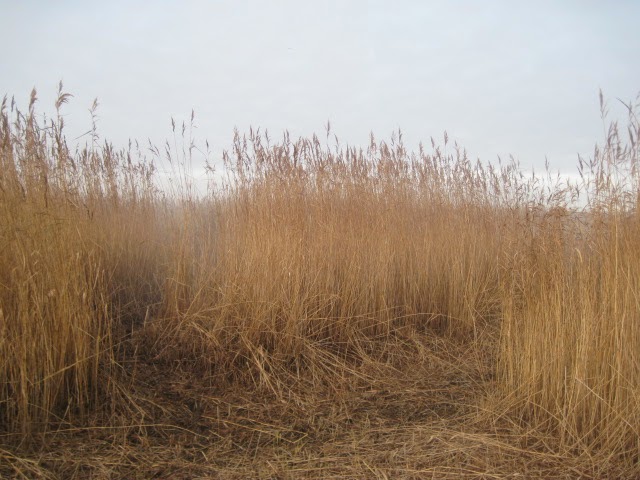 | ||||||
Typical view out in the reedbed when cutting the plots of reed. We cut over 5 hectares (5 football pitches) of reed over the winter to create a mosaic of different habitats across the reedbed, creating better conditions and more insects for Bearded Tits to feed and breed. After a week or so of cutting, it became a bit of a maze out in the reeds, and I managed to get lost more than once!
|


 |
| The massive tidal surge on 5th December resulted in a rather muddy, sticky reserve, with rubbish, reed litter, and mud covering everything. The clean-up operation took about 3 weeks, but we managed to re-open after Christmas. |
 |
| The paths and hides (see next photo) got totally covered in mud and silt, which we had to scrape off with massive snow scrapers, shovels, and stiff yard brushes. We scraped off a layer of stone and spent some time drying out and scrubbing hide floors, but we got it to a decent condition in the end! |
 |
| The good thing about the tidal surge though, is that it brought a lot of water onto the reserve, filling up the lagoons and re-wetting the reedbed and the grazing marsh, helping to create good conditions for the breeding season and attracting in a lot more ducks and geese! |
 | ||
The mud and silt on the paths also allowed animal tracks to be seen more clearly, including those of weasels, badgers, foxes, deer and birds of all shapes and sizes
|

 | ||
Things were back to normal after Christmas, and we spent some time cutting up some of the coppiced wood from last year and stacking it up for use as firewood! The driftwood that was washed up came in handy too!
|

 |
| As well as spending time at Blacktoft Sands, I also visited the RSPB reserve at Fairburn Ings, where I saw a lovely range of ducks, geese, woodland birds, and even a few Kingfishers! Well worth a visit. |
 |
| A view of sunset over one of the lakes at Fairburn Ings. |
 |
| In addition to all of the practical work, I also helped out with people engagement, including writing out information boards to go along the nature trails to the hides! Of course, the picture isn't by me - far too good to be my work! |
 |
| So here is the result of the new Softrak reed cutter/bundler - giant bales of reed! The plan is to use these reed bales to create little logs of reed which can be burnt on a fire as part of the biofuels project mentioned in my earlier post.
So there you go! A brief round-up of some of the habitat and site management things that I got involved with whilst volunteering up at Blacktoft Sands over the winter. I really enjoyed my time working on this site, especially as it's so different to what I've done previously! But at the end of March I'm heading up north once again, this time to Perth (the one in Scotland, not Australisa!) to survey a wide variety of bird species across Perthshire! I won't be based at a reserve this time, I'll be moving about all over the place, surveying wherever the birds are! I'll have my own flat and I'll be given a car to use to get around, plus I'll be getting paid! Hooray! So wish me luck for the season ahead!
|
Tuesday, 11 February 2014
Quick Update
Hi everyone, just a quick update while my internet's working (not working well enough to upload photos at the moment though). So I've been volunteering at Blacktoft Sands RSPB reserve in East Yorkshire for about 5 months now and I'm coming up to the end of my time here, but I've enjoyed every minute of it! I've gained a lot of experience in carrying out practical reserve maintenance and habitat management work, which should really haelp me to get a permanent job at some point in the future.
So what exactly have I been doing? Well, the main part of the habitat management work here at Blacktoft is that reed cutting. Every year the team here have to cut large areas of the reedbed to keep it at it's best for birds an wildlife. Reedbed specialists like Bearded Tits like to have a variety of different ages of reed - thick, tall, older stands of reed for nesting in, and open, shorter, younger areas of reed where they can easily catch insects for food. Cutting sections of reedbed is also good for the Bitterns that nest here in the summer, as they like to have short, wet areas and open pools where they can fish, as well as taller, thicker stands to nest in. It's also good for insects as we create 'edge' habitat which invertebrates love to hang around in, as do fish, increasing the biodiversity of the site. Cutting the reed creates a 'mosaic' of different micro-habitats within this habitat so dominated by one species, with a benefit to the birds and wildlife that make their homes here. 'But surely that's unnatural, cutting big holes in the habitat' - Well, yes and no. While it's true that we use machinery to cut these plots within the reedbed, this is a task that would have been completed by cattle, horses and other herbivores before humans came along, but it's impractical to have huge herds of ponies, deer, goats etc roaming across the reserve, so we have to use machinery to create the same effect. We do have 4 Konik ponies here, doing a great job of creating edge habitat around the lagoons and pathways through the reedbed, but it's a big job for four ponies so we have to help them out a bit. Click here to read more about the reed cutting and why we do it at Blacktoft.
'What do you do with all the cut reed? You can't eat it like ponies do!' No, we can't, so we have to figure out something else to do with it. At the moment, that's burning it. We heap it into big piles and burn it all away. Pretty inefficient really. However, the Blacktoft team are working to figure out something better that we can do with it - we can compress it into blocks and use it as fuel. This is a very ambitious project and one that promises a great solution to this problem with the cut reed, and would prevent us from burning in the reedbed, generate some income for the charity, and make the whole process carbon neutral! And they're having a lot of success! It's looking like this will be a real solution in the very near future, so watch this space! Please click here to read more about this project on the reserve blog!
In addition to this, we've been doing a lot of fencing work (especially after the flood in December ripped half of them down!), cleaning and repairing nest boxes for the coming season, installing electric fences, felling trees, clearing vegetation, maintaining the hides and paths, and much much more! And there's more reed cutting and some coppicing lined up for the coming month, so there's always plenty to do! I'm really enjoying my placement here (despite the lack of income) and I feel like I've learned a lot about practical conservation work, as well as seeing a lot of new birds, and it will be a shame to leave. Unfortunately though, I can't afford to be volunteering forever so I'm back on the jobs market once more! I've had a few interviews and been close to getting a couple of jobs, but no success yet. I'm still applying though, there's a lot of jobs coming up this year, so I've still got some hope! Wish me luck!
So what exactly have I been doing? Well, the main part of the habitat management work here at Blacktoft is that reed cutting. Every year the team here have to cut large areas of the reedbed to keep it at it's best for birds an wildlife. Reedbed specialists like Bearded Tits like to have a variety of different ages of reed - thick, tall, older stands of reed for nesting in, and open, shorter, younger areas of reed where they can easily catch insects for food. Cutting sections of reedbed is also good for the Bitterns that nest here in the summer, as they like to have short, wet areas and open pools where they can fish, as well as taller, thicker stands to nest in. It's also good for insects as we create 'edge' habitat which invertebrates love to hang around in, as do fish, increasing the biodiversity of the site. Cutting the reed creates a 'mosaic' of different micro-habitats within this habitat so dominated by one species, with a benefit to the birds and wildlife that make their homes here. 'But surely that's unnatural, cutting big holes in the habitat' - Well, yes and no. While it's true that we use machinery to cut these plots within the reedbed, this is a task that would have been completed by cattle, horses and other herbivores before humans came along, but it's impractical to have huge herds of ponies, deer, goats etc roaming across the reserve, so we have to use machinery to create the same effect. We do have 4 Konik ponies here, doing a great job of creating edge habitat around the lagoons and pathways through the reedbed, but it's a big job for four ponies so we have to help them out a bit. Click here to read more about the reed cutting and why we do it at Blacktoft.
'What do you do with all the cut reed? You can't eat it like ponies do!' No, we can't, so we have to figure out something else to do with it. At the moment, that's burning it. We heap it into big piles and burn it all away. Pretty inefficient really. However, the Blacktoft team are working to figure out something better that we can do with it - we can compress it into blocks and use it as fuel. This is a very ambitious project and one that promises a great solution to this problem with the cut reed, and would prevent us from burning in the reedbed, generate some income for the charity, and make the whole process carbon neutral! And they're having a lot of success! It's looking like this will be a real solution in the very near future, so watch this space! Please click here to read more about this project on the reserve blog!
In addition to this, we've been doing a lot of fencing work (especially after the flood in December ripped half of them down!), cleaning and repairing nest boxes for the coming season, installing electric fences, felling trees, clearing vegetation, maintaining the hides and paths, and much much more! And there's more reed cutting and some coppicing lined up for the coming month, so there's always plenty to do! I'm really enjoying my placement here (despite the lack of income) and I feel like I've learned a lot about practical conservation work, as well as seeing a lot of new birds, and it will be a shame to leave. Unfortunately though, I can't afford to be volunteering forever so I'm back on the jobs market once more! I've had a few interviews and been close to getting a couple of jobs, but no success yet. I'm still applying though, there's a lot of jobs coming up this year, so I've still got some hope! Wish me luck!
Sunday, 8 December 2013
A Close Call...
So you may have heard on the news about the severe flooding that hit Britain last week, with thousands of homes flooded out due to the large tidal surge, flooding towns all along the east coast. This was the largest coastal surge to hit the North Sea coastline in the past 60 years, brought about by combination of three factors all occuring at once, a lethal combination. Spring tides, the highest astronomical tides of the lunar cycle, combined with a low pressure system and very high winds across the North Sea (up to 80mph in places) to form a massive tidal surge, pushing over flood defenses and destroying flood banks in many areas. People were evacuated all along the East coast, thousands of homes were flooded, power was knocked out in many locations, lamp posts ripped up, walls torn down, and general destruction along the coast. And it was no different here!
Being located in the 'V' where the River Ouse and the River Trent meet to form the Humber, we were on flood warning quite early on, although it wasn't expected to reach Whitgift (where I'm living), although later on we were upgraded to flood warning as the tidal surge began. People living in Goole and in some villages along the Trent were evacuated, and Whitby, Hull and Boston were all badly affected by the flooding. As we weren't on flood alert until late in the day, we thought we were relatively safe, although we did move the Konik ponies to higher ground on the reserve to ensure that they would be ok as we expected the reserve would get very flooded, being right in the junction where the two rivers meet. We didn't expect it to be quite so bad as it was though... I got a phone call at about 7:45pm on Friday, when the tide was almost at its highest, to say that the the water was pouring over the floodbank, and heading towards the village, and that we probably had about 20 minutes to get everything upstairs before the waters came flooding in...
So we moved things upstairs, and got prepared to turn off the electrics and retreat upstairs at the first sign of flooding. Luckily though, the waters seemed to bypass Ousefleet and Whitgift and carried on past us! Unfortunately Reedness, the next village along, got hit very badly when part of the floodbank collapsed and the waters came rushing in, with walls destroyed and homes flooded, as the water reached up to car windows on its way through and out across the fields behind the village. So we got off very lightly really, our side of Whitgift wasn't touched at all, and the villages this side of the river weren't too badly affected. The floodwaters in Reedness have now subsided, although debris still litters the pathways and gardens.
The reserve however did get pretty badly battered, with waters reaching halfway up some of the hides, coating everything in mud and silt, pathways underwater and debris everywhere. Tomorrow the clean up begins, a task that will take quite a while by the sounds of it! Some things have been rescued from the visitor centre, but a lot of the stock was totally ruined. However, I am pleased to report that all four of the Konik ponies are ok. We got a bit worried about them when we couldn't find them on Friday night when all of the flooding happened, but as it turned out they had just jumped the fence in a bit of a panic. They got separated in pairs somehow during the flood, but they have all been relocated and moved out of the reedbed to somewhere a bit safer. They'll be checked over by the vet at some point this week as well, just to make sure they're fine. I'll post up some photos of the reserve next week, but we're hoping to be open again by next weekend. We're out of danger now though, so should be fine from here on out!
For more info and pictures (for those of you that haven't already seen them), click on the following links:
BBC News Report - General overview and explains more about tidal surges
BBC Local News - Yorkshire
Some photos - scroll to bottom of page
Being located in the 'V' where the River Ouse and the River Trent meet to form the Humber, we were on flood warning quite early on, although it wasn't expected to reach Whitgift (where I'm living), although later on we were upgraded to flood warning as the tidal surge began. People living in Goole and in some villages along the Trent were evacuated, and Whitby, Hull and Boston were all badly affected by the flooding. As we weren't on flood alert until late in the day, we thought we were relatively safe, although we did move the Konik ponies to higher ground on the reserve to ensure that they would be ok as we expected the reserve would get very flooded, being right in the junction where the two rivers meet. We didn't expect it to be quite so bad as it was though... I got a phone call at about 7:45pm on Friday, when the tide was almost at its highest, to say that the the water was pouring over the floodbank, and heading towards the village, and that we probably had about 20 minutes to get everything upstairs before the waters came flooding in...
So we moved things upstairs, and got prepared to turn off the electrics and retreat upstairs at the first sign of flooding. Luckily though, the waters seemed to bypass Ousefleet and Whitgift and carried on past us! Unfortunately Reedness, the next village along, got hit very badly when part of the floodbank collapsed and the waters came rushing in, with walls destroyed and homes flooded, as the water reached up to car windows on its way through and out across the fields behind the village. So we got off very lightly really, our side of Whitgift wasn't touched at all, and the villages this side of the river weren't too badly affected. The floodwaters in Reedness have now subsided, although debris still litters the pathways and gardens.
The reserve however did get pretty badly battered, with waters reaching halfway up some of the hides, coating everything in mud and silt, pathways underwater and debris everywhere. Tomorrow the clean up begins, a task that will take quite a while by the sounds of it! Some things have been rescued from the visitor centre, but a lot of the stock was totally ruined. However, I am pleased to report that all four of the Konik ponies are ok. We got a bit worried about them when we couldn't find them on Friday night when all of the flooding happened, but as it turned out they had just jumped the fence in a bit of a panic. They got separated in pairs somehow during the flood, but they have all been relocated and moved out of the reedbed to somewhere a bit safer. They'll be checked over by the vet at some point this week as well, just to make sure they're fine. I'll post up some photos of the reserve next week, but we're hoping to be open again by next weekend. We're out of danger now though, so should be fine from here on out!
For more info and pictures (for those of you that haven't already seen them), click on the following links:
BBC News Report - General overview and explains more about tidal surges
BBC Local News - Yorkshire
Some photos - scroll to bottom of page
Thursday, 7 November 2013
A Wetland Wonderland
People often ask me what it’s like to work on a nature
reserve and live in a remote area ; ‘How do you get shopping?’, ‘What do you do
for fun?’, ‘You’re living so far from
civilisation, there’s not even a STARBUCKS near you, how do COPE???’ and ‘Do
you really like living alone? I mean, you’re so ALONE, so lonely and alone. All
ALONE.’ are just some of the questions I
deal with on a regular basis. But really, it’s not as bad as everyone seems to
think it is! They see that I’m in the frigid north and assume it’s just me and
the polar bears for miles around, living in a bleak, sunless wilderness,
suffering through grey days and greyer nights, with no hope of brighter days to
come. And yes, it is getting colder, winter is coming, but it’s not so bleak as
you might think. The reserve here is lovely, and I really do enjoy being
surrounded by countryside! I much prefer rolling green hills, farmland,
woodland and lakes to the depressing urban jungle that defines our towns and cities
across the land, with their towering buildings, rat-infested parks and rubbish tips, where the streets are paved
with dog poop. I enjoy the quiet relaxation of the countryside, its
peacefulness and the friendliness of its residents. And that’s exactly what I
get in my current role! Don’t get me wrong, it is nice to spend some time in
our towns and cities, meeting up with friends, going out clubbing, shopping,
drinking, eating out, and generally being a bit more classy and whatnot, but
I’m very glad to get away from it all by working outdoors in these lovely
remote places.
 |
| The loveliness of rural life |
‘So what’s so great about this nature reserve?’ I
hear you cry. Well, it’s just a bit different from everywhere else that I’ve
worked before really! Whereas the reserves I was working on in Orkney and the
Farne Islands are seabird reserves, tall cliffs covered with nesting seabirds
and smelling a bit fishy, with some nice vegetated bits and lots of nice birds
and wildlife a bit further inland, and Loch Ruthven was a large loch surrounded
by woodland and heathland, Blacktoft Sands is basically one big reedbed with
lots of pools, big and small, throughout the reeds. It’s set in between two
rivers, the Ouse and the Trent, jutting out into the channel where the two rivers
meet to form the Humber, surrounded by Scunthorpe, Hull, York, Leeds and
Doncaster. My nearest town is Goole, an industrial little place known mostly
for it’s part in the ship-building industry, and I regularly spy ships coming
up the Ouse, past the reserve, past my house, and on towards Goole. Which is
slightly surreal actually, as from street level it looks as if the ships are
carving their way through fields… Anyway, the reserve is pretty big, although
only a small area is open to the public, as the majority of the reserve is
reedbed. Despite that though, there are 7 bird hides, each one looking out onto
a different pool, with different birds on each, except Ousefleet hide, which
looks out onto the grazing marsh, a drier bit of land that’s grazed in by
cattle and used by breeding waders and wintering wildfowl.
 |
| Here’s an aerial photo of the reserve, showing the rivers, the pools that the hides look onto, the areas where the reeds have been cut, and the extent of the reedbed. |
 |
| A typical view from one of the hides |
 |
| Some lovely trees as well |
The reserve is best known for the Marsh Harriers which breed
and over-winter in the reedbed. They have been very successful over the past
couple of summers, but over winter they get large numbers of these beautiful
birds of prey roosting in the reeds overnight, along with a few Hen Harriers
too. These birds have come in from the continent and need a nice place to sleep
for the night, and where better? They all start arriving as the day turns to
dusk, with as many as 30 Harriers seen in the sky at once, then one-by-one they
drop into the reedbed to have a little sleepy – a wonderful sight to behold!
The roost is only now beginning, with about 8 Marsh Harriers and 2-3 Hen
Harriers seen coming in to roost recently, but these numbers will build as
winter deepens, with the chance of seeing Owls as well! What could be
better? But during the day, there’s a
wide variety of waders, ducks, geese with Bearded Tits, Reed Buntings and TreeSparrows flitting about, and Redwings and Fieldfares passing by overhead. I’ve
seen a nice variety of birds since I’ve been here, and I’ve only been here a
month! I think some of the winter birds
have been the nicest birds so far – Whooper Swans and Pink-footed Geese and
Brent Geese. But the waders have been great too and I’ve learnt to recognise a
few species that I couldn’t identify before, which is always great!
In addition to all of this though, we’ve also got four
lovely Konik ponies. These are an ancient Polish breed of horse, much better
adapted to life in a wetland environment than most other breeds are. They are
used in Poland to graze and manage the large areas of reedbeds, as they are
happy to wade around in water and are less susceptible to getting foot problems
from spending a lot of time in water – a big problem for some breeds. They are
hardy little guys, and they love to eat the reeds, so they are helping to
manage the habitat here! They eat the reeds back and help to create pathways
through the reeds and shorter areas of reeds that many reedbed birds and wildlife
like to feed and shelter. The Koniks are here for three years as part of a
wider project to find ways to manage the habitat more naturally. Most of the
habitat management work that goes on here is done by machinery, such as
brushcutters. Plots are cut in the reedbed each year on a rotation so that each
area is cut every few years. This helps to provide a mosaic of habitats, with
areas of younger shorter reeds for birds like Bitterns to feed in, as well as
taller, older stands of reed for birds like the Bearded Tit to nest in. In this
way, we can keep the reedbed at its best and provide habitat for all of its
residents!
 |
| A very nice photo of a very photogenic Konik pony. Unfortunately not one of my photos though! |
 |
This photo shows some of the plots where reeds have been cut in previous years, and the ditch that feeds all of the pools. |
This reed cutting work will be continued again this year, as
this is what me and the team will be doing for a lot of the winter, creating a
more varied habitat for the reedbed residents, both the permanent and
over-wintering ones. In addition to this we’ll be carrying out a few more
habitat management and maintenance tasks to keep the reserve looking its best,
so both people and wildlife can enjoy this wetland
wonderland!
Subscribe to:
Posts (Atom)