Showing posts with label Orkney. Show all posts

Thursday, 7 November 2013

A Wetland Wonderland


People often ask me what it’s like to work on a nature reserve and live in a remote area ; ‘How do you get shopping?’, ‘What do you do for fun?’, ‘You’re  living so far from civilisation, there’s not even a STARBUCKS near you, how do COPE???’ and ‘Do you really like living alone? I mean, you’re so ALONE, so lonely and alone. All ALONE.’  are just some of the questions I deal with on a regular basis. But really, it’s not as bad as everyone seems to think it is! They see that I’m in the frigid north and assume it’s just me and the polar bears for miles around, living in a bleak, sunless wilderness, suffering through grey days and greyer nights, with no hope of brighter days to come. And yes, it is getting colder, winter is coming, but it’s not so bleak as you might think. The reserve here is lovely, and I really do enjoy being surrounded by countryside! I much prefer rolling green hills, farmland, woodland and lakes to the depressing urban jungle that defines our towns and cities across the land, with their towering buildings, rat-infested parks and  rubbish tips, where the streets are paved with dog poop. I enjoy the quiet relaxation of the countryside, its peacefulness and the friendliness of its residents. And that’s exactly what I get in my current role! Don’t get me wrong, it is nice to spend some time in our towns and cities, meeting up with friends, going out clubbing, shopping, drinking, eating out, and generally being a bit more classy and whatnot, but I’m very glad to get away from it all by working outdoors in these lovely remote places.
The loveliness of rural life
‘So what’s so great about this nature reserve?’ I hear you cry. Well, it’s just a bit different from everywhere else that I’ve worked before really! Whereas the reserves I was working on in Orkney and the Farne Islands are seabird reserves, tall cliffs covered with nesting seabirds and smelling a bit fishy, with some nice vegetated bits and lots of nice birds and wildlife a bit further inland, and Loch Ruthven was a large loch surrounded by woodland and heathland, Blacktoft Sands is basically one big reedbed with lots of pools, big and small, throughout the reeds. It’s set in between two rivers, the Ouse and the Trent, jutting out into the channel where the two rivers meet to form the Humber, surrounded by Scunthorpe, Hull, York, Leeds and Doncaster. My nearest town is Goole, an industrial little place known mostly for it’s part in the ship-building industry, and I regularly spy ships coming up the Ouse, past the reserve, past my house, and on towards Goole. Which is slightly surreal actually, as from street level it looks as if the ships are carving their way through fields… Anyway, the reserve is pretty big, although only a small area is open to the public, as the majority of the reserve is reedbed. Despite that though, there are 7 bird hides, each one looking out onto a different pool, with different birds on each, except Ousefleet hide, which looks out onto the grazing marsh, a drier bit of land that’s grazed in by cattle and used by breeding waders and wintering wildfowl.
Here’s an aerial photo of the reserve, showing the rivers, the pools that the hides look onto, the areas where the reeds have been cut, and the extent of the reedbed.
A typical view from one of the hides
Some lovely trees as well
The reserve is best known for the Marsh Harriers which breed and over-winter in the reedbed. They have been very successful over the past couple of summers, but over winter they get large numbers of these beautiful birds of prey roosting in the reeds overnight, along with a few Hen Harriers too. These birds have come in from the continent and need a nice place to sleep for the night, and where better? They all start arriving as the day turns to dusk, with as many as 30 Harriers seen in the sky at once, then one-by-one they drop into the reedbed to have a little sleepy – a wonderful sight to behold! The roost is only now beginning, with about 8 Marsh Harriers and 2-3 Hen Harriers seen coming in to roost recently, but these numbers will build as winter deepens, with the chance of seeing Owls as well! What could be better?  But during the day, there’s a wide variety of waders, ducks, geese with Bearded Tits, Reed Buntings and TreeSparrows flitting about, and Redwings and Fieldfares passing by overhead. I’ve seen a nice variety of birds since I’ve been here, and I’ve only been here a month!  I think some of the winter birds have been the nicest birds so far – Whooper Swans and Pink-footed Geese and Brent Geese. But the waders have been great too and I’ve learnt to recognise a few species that I couldn’t identify before, which is always great!

In addition to all of this though, we’ve also got four lovely Konik ponies. These are an ancient Polish breed of horse, much better adapted to life in a wetland environment than most other breeds are. They are used in Poland to graze and manage the large areas of reedbeds, as they are happy to wade around in water and are less susceptible to getting foot problems from spending a lot of time in water – a big problem for some breeds. They are hardy little guys, and they love to eat the reeds, so they are helping to manage the habitat here! They eat the reeds back and help to create pathways through the reeds and shorter areas of reeds that many reedbed birds and wildlife like to feed and shelter. The Koniks are here for three years as part of a wider project to find ways to manage the habitat more naturally. Most of the habitat management work that goes on here is done by machinery, such as brushcutters. Plots are cut in the reedbed each year on a rotation so that each area is cut every few years. This helps to provide a mosaic of habitats, with areas of younger shorter reeds for birds like Bitterns to feed in, as well as taller, older stands of reed for birds like the Bearded Tit to nest in. In this way, we can keep the reedbed at its best and provide habitat for all of its residents!
A very nice photo of a very photogenic Konik pony. Unfortunately not one of my photos though!

This photo shows some of the plots where reeds have been cut in previous years, and the ditch that feeds all of the pools.
This reed cutting work will be continued again this year, as this is what me and the team will be doing for a lot of the winter, creating a more varied habitat for the reedbed residents, both the permanent and over-wintering ones. In addition to this we’ll be carrying out a few more habitat management and maintenance tasks to keep the reserve looking its best, so both people and wildlife can enjoy this wetland wonderland!

Tuesday, 10 September 2013

End of Season Round-up!

Well, that's it now, the breeding season is over and I'm no longer in Orkney. So how did the season go for our breeding birds? Well, in short, it wasn't great. Due to the cold weather lasting throughout May and well into June, many of the seabirds were late to start nesting, and we saw fewer pairs returning to the cliffs to nest this year; this may be because the adults weren't able to find enough food over winter and were therefore in too poor a condition to breed this year, or it could be due to other circumstances - the large wrecks of seabirds over winter may have had an effect. Whatever the reason, they didn't do so well. However, some others did do fairly well, so here's a quick species-by-species run down. I monitor the seabirds in 7 plots along the cliff face on the North Hill reserve, and the following results relate to those 7 plots.

Only 1 pair of Kittiwakes attempted to nest this year. However, this pair didn't complete their nest and laid no eggs. No fledged young were seen around the cliffs on Papa Westray at all this year, so it is likely that none fledged at all from anywhere along the cliffs. This is a species that has declined massively in the past 10 years or so due to the lack of food availability - they need Sandeels to be close to the water's surface in order to feed, but due to climate change there are fewer Sandeels at the right depth for these birds.
Kittiwakes on nests
Guillemots also did badly this year, with no chicks fledged from the 78 nesting pairs that I monitored. This was mainly due to high levels of predation of Guillemot eggs and chicks by gulls and skuas, although lack of food almost certainly played a part. Fewer birds returned to nest this year, which is always an issue for Guillemots as they adopt a 'safety in numbers approach' - cramming as many nesting birds onto the breeding ledges as possible to reduce the chances of predation. But as Guillemot numbers drop, protection from predators drops, and so the number of fledged chicks drops.
Guillemots with chicks - not a common sight on Orkney this year
Razorbills fared slightly better though, with 5 chicks fledged from 27 pairs - very similar numbers to last year, showing that their choice of nesting spot (within small cracks in the cliff face) is beneficial to prevent predation of young.
Razorbill pair with egg
Shags did well as they always do, and had the highest productivity (number of chicks fledged per pair) of all of the breeding seabirds this year! From 9 nests, 13 chicks fledged! Shags tend to do much better than other species as they eat a wider variety of prey, they can dive quite deep to catch their prey (up to 45m!) and they defend their nests quite viciously so predators ususally go for something a bit easier!
Shag on nest
The Gannets nesting on Noup Cliffs also did quite well this year, with the number of nesting birds increasing to 673, with 464 chicks fledged! Gannets are our largest seabird, and they will eat anything they can find, diving deep if necessary, so they usually do better than our other seabirds!
Gannets nesting on Noup Cliffs
Fulmars are another species that usually do well as they spit horrible smelly fishy oil at any predators that get too close to their nest, but this year and last year they have shown very poor productivity. Only 6 chicks fledged from 137 nests this year - a terrible result. We think this might be due to the Ravens that have moved to the cliffs on North Hill predating the vulnerable chicks whilst the parents are away fishing, but it could be due to poor weather conditions when the chicks are small , or due to the lack of food around Orkney and Shetland. Research has shown that some of the Fulmars nesting in Orkney will go as far as Norway to get food for their chick! A long journey indeed!
Fulmar nesting on Papa Westray
Great Skuas are one of those Marmite birds - you either love them or hate them. Personally, I love them! They're such beautiful birds with so much character! But I do understand why some people don't like them - they are a big predator of our other nesting seabirds. However, they only predate the seabirds as they can't find enough fish to feed their chicks, so they have to resort to taking the eggs and chicks of other seabirds in order to raise their chicks. It's a strategy that works! From 24 pairs, 17 chicks fledged! And as there are only about 10,000 nesting pairs globally, about 60% of which nest in Scotland, I call that a win!
Awwww! Cute Great Skua chick on North Hill
Unfortunately though, our other skua species, the Arctic Skua, did not do so well. They are one of the species predated by Great Skuas as well as gulls, and they have been declining for some time now. This year we had just 17 pairs nesting and no chicks fledged, giving the first year of zero productivity since they first started nesting here.
Unfortunately I seem to be unable to get a decent photo of an Arctic Skua, so I've taken this one from a Google search.
Arctic Terns also had a very bad year due mostly to the poor weather at the start of the season. They didn't start nesting until early June this year, and only 2 colonies laid eggs. Most of these nests only had 1 egg however, a sign that the adults were in very poor breeding condition (most likely due to a lack of food over winter and before breeding), as they didn't have the energy to produce more than one egg - they usually lay 2 or 3. They are also predated by both Arctic Skuas and Great Skuas, and probably by the gulls as well. They didn't manage to fledge any chicks this year, the fourth year in a row with no fledged Arctic Tern chicks.
A beautiful Arctic Tern
It's not all doom and gloom though! Black Guillemots showed an increase in pre-breeding numbers, and with further study we will be able to relate this to the actual number of breeding pairs. The population of nesting Dunlin also increased to their highest number in the past 10 years, and the small colony of Sandwich Terns on Papa Westray (the only colony in Orkney as far as I'm aware) raised between 16-18 chicks from 20 pairs! Twite also did very well, with most pairs seen with chicks later on in the season. The pair of Golden Plovers did well too and managed to raise 3 healthy chicks, so it looks like the cold, wet season was good news for our breeding waders!


'So what now?' I hear you ask, 'You're finished in Orkney, where are you jetting off to next!?' Well, at the moment I'm back at home while I sort things out, buy some new equipment, catch up with family and friends, and apply for jobs! But hopefully at the end of September I'll be going up to Yorkshire to stay at Blacktoft Sands RSPB reserve as a Residential Volunteer! I'm going up there this Friday to check it all out and see what the reserve is like. I know they have a few other people that they're talking to but hopefully I'll get the placement! It's not paid, but I get free accommodation on the reserve, my travel will be paid for, and I'll get loads of useful experience which will help me to get a paid job next winter! So wish me luck!

P.S. - A massive CONGRATULATIONS to my best friend Connie who got married last weekend! You look amazing in that dress, I'm so happy for you both! :D

Saturday, 15 June 2013

Surveys, seabirds and sunshine!

June is the busiest month in any conservation job. The breeding season in in full swing, with birds either sitting on eggs or looking after their newly hatched chicks, visitors are everywhere, and there are about a million surveys to do. But it's even busier on seabird sites, as June is when counts, surveys and monitoring of the breeding seabirds begins! I've been kept incredibly busy since I first arrived back here in April, but since the start of June I've been twice as busy as before! I'm doing seabird counts and monitoring two or three times a week, which involves sitting and watching the birds or an hour or two at each of my seven monitoring sites, and waiting for them to move slightly so that I can see whether they have eggs or chicks - it sounds tedious, and it can be if the birds aren't cooperating, but most of the time I enjoy it! Especially if the weather's nice! 
Nesting season also means attacking season for some of our seabirds! This is a Great Skua, and he's very annoyed at me for being in his territory! Photo taken just before he hit me in the head with his feet!
I've also been continuing with my surveys of all of the other birds that nest on the North Hill reserve (on Papa Westray), doing my guided tours twice a week, and of course doing paperwork and going to team meetings! June is also THE time to count seabird colonies, and that is exactly what me and the RSPB team spent last Saturday doing! Read more about this on our RSPB Orkney Blog. So, I've definitely been kept busy so far this month, and I'm sure there will be many more things for me to as the month continues!

It's not all work, work, work though, and I have found the time to go to many of the social events here on the island! I go to the cinema nights and pub nights whenever I can, and I really enjoy the Coffee Morning on Wednesdays - some of the best cake I've ever had, not to mention the cheese scones! And I was even asked to bake for the coffee mornings a few times now - a high honour indeed!
I made Chocolate Cherry Cheesecake Brownies. They seemed to go down well, what do you think?
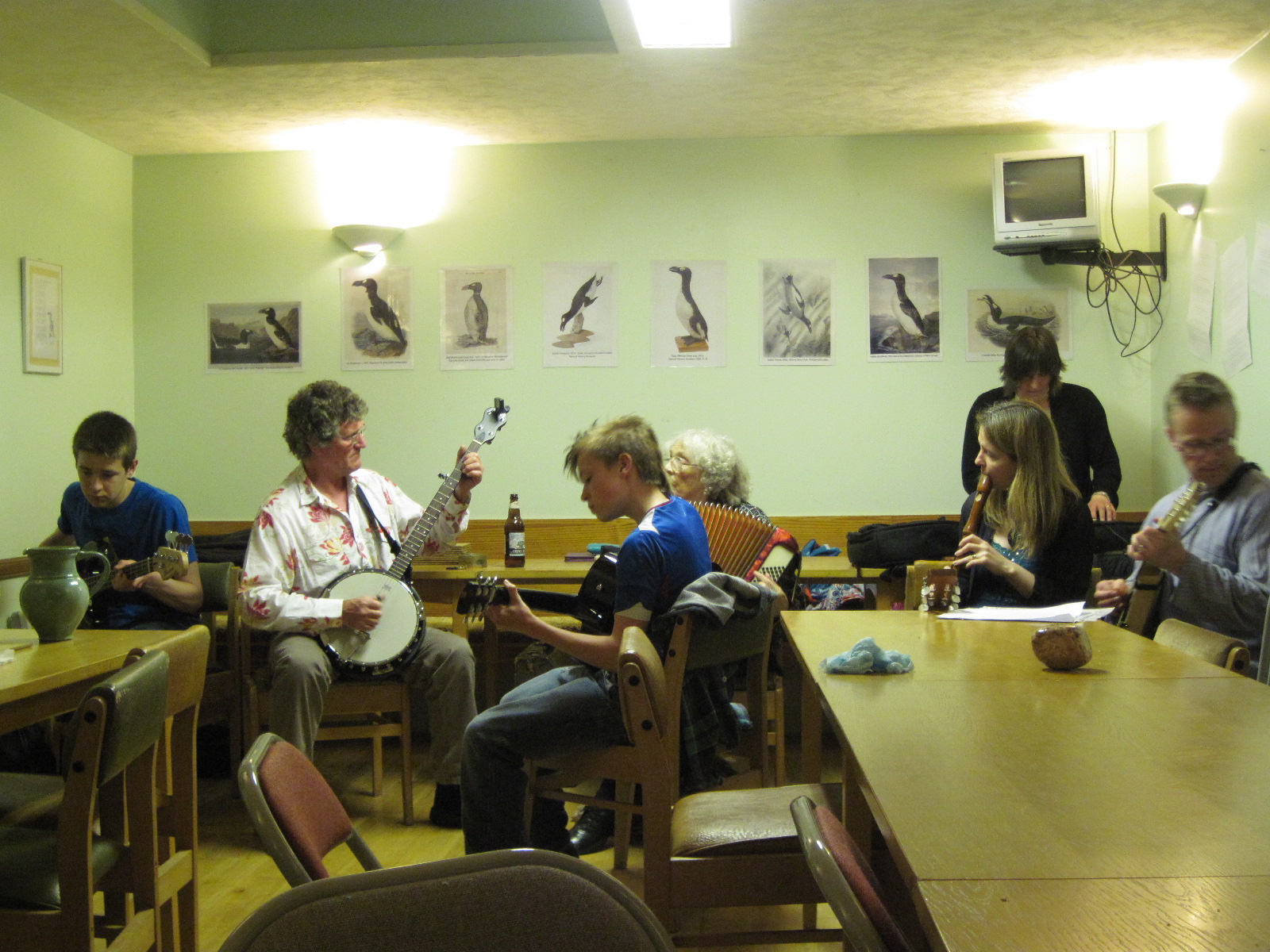
I've even had a visitor come to stay, which I feel would have been more interesting if I hadn't been working the whole time, but despite that, it's still a wonderful place to come and visit! But the main social event of the year so far has to be the AAKnowledge weekend, commemorating the last pair of Great Auks in Britain, which bred on Papay. The male of the pair was killed in May 1813, the female was killed the year before, so this was the 200th anniversary of it's death which we commemorated. It was a lovely weekend, with dances, dinners, a farmer's marknet, a walk up to the Great Auk statue, and talks by a variety of people, including a very informative talk by Dr Jo Cooper, who looks after the Papay Great Auk at the Natural History Museum in Tring. We even had a 3D representation of the Papay Auk, as unfortunately it is too fragile to make the journey all the way up here. A wonderful weekend, which hopefully helped to spread the story of the Great Auk and it's extinction, and to point out the many similarities between it's extinction and the current decline that we are seeing in our seabirds up here and elsewhere across the UK and Europe. The weekend was made even nicer as a few people from the office came up to stay and join in the festivities! 

The AAKnowledge Poster
Commemorative tea-towel - everyone on the island drew an Auk! Can you find mine? HINT: I did a Black Guillemot
The Papay Band playing on the Sunday night after the talks and a mighty feast!
The 3D Auk. This is the actual one that was killed on Papa Westray in 1813 and is the only surviving British specimen. It looks better when you actually see it in 3D!
Even the beer was Auk themed!
The AAKnowledge weekend was part of the larger Orkney Nature Festival, ran by the RSPB with support from various other organisations to get people more interested in Orkney nature and wildlife, and to get people out to look at that wildlife! The festival lasted just over a week and included a wide variety of events both on Mainland Orkney and on several of the islands. Unfortunately I didn't get to attend very many of the events as I had walks and surveys to do, but I did manage to get to the events on Westray up at our Noup Cliffs reserve, and was lucky enough to go on the boat trip around the cliffs - a lovely and unique way to experience this seabird city! I also went to a few events on Mainland, including a guided walk and market!
Approaching Noup Cliffs on the boat trip for the Orkney Nature Festival

75m high and covered in seabirds!
Me on the boat trip round the cliffs! (Won't let me make it the right way up...)
Anne's amazing mural on the wall of the office for the Orkney Nature Festival's marine day
In bird news, the season has been off to a very slow start, with the cold weather continuing well into May. We saw many late migrants coming through, and noticed that most birds were quite late in nesting and egg-laying, a trend which is evident all across the UK. However, things are starting to look up, as all species are now either on eggs or with young chicks. The species that seems to have been worst affected by the extended cold spell seems to be the Arctic Terns. Many passed through in late May as the weather got a bit warmer, but our breeding birds didn't return until early June and are only now starting to lay. Their numbers are much lower than last year, across both Westray and Papay, but I'm hoping it's just going to be a late season for them. Another species that seems to have been greatly effected is the Corncrake. Orkney is one of the few places in Britain that Corncrakes still breed, but this year we seem to have a lot fewer birds. Last year there were 12 males on Westray and 1 on Papay, but this year it looks like there's just 5 on Westray, and none at all on Papay. It's likely that the cold weather put them off of their migration, and that they just stayed in Europe to breed rather than making the extra journey over here. It will be very interesting to see how both of the species do over the season, but I'm hoping that things get better for them soon! The weather has significantly improved now, with many warm, sunny days, low winds, and general niceness, and long may it last!
An amazing sunset after an evening spent surveying Curlews across the island

Sunday, 21 April 2013

Winter 2012 / Early 2013

Hello everyone, sorry that I haven't posted anything in a while, I was having issues logging in! Anyway, that's all sorted now, so I can give you all a very brief catch-up of what I've been up to over the winter and what I'm doing currently. I've noticed that my blog post about Poland seems to have disappeared which is quite annoying, but I'll re-write that one later.

So as you may know, after leaving Orkney in August last year I went on a weeks trip to Poland, which was simply amazing! After my lovely week in Poland, I went back to stay with my mum and sister in Hertfordshire as I didn't manage to find any paid conservation work over the winter, although I did manage to do quite a lot of volunteering! I volunteered with my local conservation charity, the Box Moor Trust and did lots of practical volunteering like clearing out ponds, cutting down trees, and generally keeping their areas of land looking nice and ensuring that the habitat is good for the birds! They're a lovely group, the work is pretty fun (when it's sunny anyway) and it's a really good workout! I definitely enjoyed volunteering with them and will be returning to help them out again next year!
Clearing out a pond with the Box Moor Trust
I also volunteered at RSPB Headquarters at Sandy, Bedfordshire, answering emails and letters about the Big Garden Birdwatch survey that they run each year. This survey takes place at the end of January each year and simply involves counting all of the birds in your garden for an hour. Over half a million people got involved in the survey, which provides the RSPB with a lot of data and helps them to spot trends, such as the decline in House Sparrows and Starlings which we have been seeing in recent years. It's a lovely way to spend an hour, so get involved next year! In addition to this, I also spent some time volunteering at Verulamium Park in St Albans, showing people the Herons that breed on the island in the middle of the lake there. Unfortunately I didn't manage to see any chicks as I had to leave to go back to my summer job, but I'm told that they had quite a few chicks, despite the cold weather!

So despite not finding a full-time job over the winter, I did still manage to do some volunteering and had a lot of fun! I even managed to go to Birmingham for a weekend of bird ringing with my trainer. We caught a wide variety of species over the weekend, the nicest of which was seven Great-spotted Woodpeckers!! An amazing catch! I do have some photos of the ringing activities, but they're all on my phone...I'll add them in once I get the cable! (I managed to email a couple of photos to myself from my phone)
A Willow Tit, quite rare in Britain now.

One of the 7 Great-spotted Woodpeckers that we caught. This one's a boy, as it has red on the back of it's head.
Shortly after leaving Orkney, I decided that I definitely wanted to return to the job and the island in 2013 for a second season, so I didn't really spend much time over winter looking at advertised cosnervation jobs! Early this year, I accepted the post as Orkney North Isles Warden. I bought some new gear (including some rather expensive new walking boots) and then made the move back up to the islands in late March! I decided this time to do the journey as cheaply as possible, which turned out to be an overnight coach from London to Aberdeen, and then the ferry from Aberdeen to Kirkwall (Orkney). I won't lie, the journey was pretty rough and I was knackered by the time I got to Orkney (at 11pm) but it was cheap! Only £33!! I stayed over in Kirkwall that first night, then got the ferry over to Papa Westray, as I had a lot of luggage and would have had to pay extra if I'd taken it on the little plane! Over the winter, Amy (the Corncrake Officer last year and again this year) stayed in Rose Cottage, my little house on Papa Westray, so it was lovely and clean and warm when I arrived - bonus!!
Back at Rose Cottage!
I've only been here a few weeks so far, but I'm really enjoying being back! It really is a wonderful place to spend the summer, and although it hasn't been the best weather (pretty windy) it's much nicer than it was 'doon sooth'! The community seems to have welcomed me back with open arms, so it actually feels quite like I never left, which can't be a bad thing! Since I've been back I've mostly been sorting stuff out for the up coming season, getting everything organised, and doing lots of Black Guillemot surveys! Black Guillemots are one of my favourite birds. They are auks, which means that they are related to Puffins, Razorbills and Guillemots, three species that also nest up on the reserve here. But I think the Black Guillemots (known up here as Tysties) are my favourites of the group, although Razorbills are a close second! Tysties are just so beautifully coloured though. Pure black all over, apart from a little white blob on each wing, with bright red feet! They are best seen in the early mornings and late evenings when they can be seen in large groups on the sea around their breeding grounds, whent hey can be heard making a wonderful whistling noise - much better than the strange growly noises that Puffins make!
Black Guillemots down by the pier on Papa Westray


Black Guillemots nest in 'burrows', by which I mean gaps between large boulders, under rocks, in caves, and generally anywhere rocky and inaccessable, which is probably why they are doing quite well in comparison to other seabirds that nest on the open cliffs. It does make monitoring them much harder though, as they usually nest in places that people can't reach! So this year, I have made some 'Tystie Cairns' - piles of rocks with a little entrance hole and some sand/gravel in the middle so that the egg/chick will be comfortable. It also means that monitoring them might be a bit easier! Let's hope that they choose to use at least some of them!
One of the Tystie Cairns. You can just about see the entrance, down and to the right of the number 1
I think that's about all for now, I'll try to update this blog much more regularly now that I can actually access it again, and will keep you all updated on Orkney life!

Sunday, 13 May 2012

Happy on Papay!

So here I am, living and working on one of the smallest islands in Orkney - Papa Westray, known affectionately by the locals as 'Papay', and I'm loving it! Sure, I'm here on my own, living in a small, rather draughty little cottage (Rose Cottage - it's pink!), far away from all of the people I know, but it's a lovely place to be and I'm just enjoying being here!


Rose Cottage - my home until August
I'm the only RSPB staff living on the island, and I work to look after the RSPB reserve here called North Hill. It's a rather large area of land (25% of the entire island!) and is made up of a variety of habitats: squelching bogs, sheer cliff faces, boulder beaches, small pools, and the rarest of all - maritime heathland. This is a habitat seriously in decline, with Papa Westray holding one of the largest areas of maritime heathland in Europe - and it's not exactly a big island! This is the habitat that SNH (Scottish Natural Heritage - the Scottish equivalent of DEFRA) are working to maintain. This habitat is important not just because of it's rarity, but also because it is home to a wide range of species. In the summer the heathland comes to life as a carpet of wildflowers. In addition to this, many bird species like to nest in this habitat, including Skuas, Terns and a variety of waders, all of which I am required to survey and monitor in my new job as Warden here. In addition to my bird monitoring work, I also give guided tours of the reserve twice a week, maintain the bird hide and do counts of the diminutive Scottish Primrose. Only found in Caithness, Sutherland and 6 of the Orkney isles, the Scottish Primrose is one of our rarest endemic plants, and I have the task this year of surveying the whole of the North Hill reserve for these easily-overlooked little flowers. I am also responsible for looking after the RSPB reserve on Westray, our neighbouring island, called Noup Cliffs - home to 600 pairs of breeding Gannets, as well as thousands of other breeding seabirds. Since arriving here, I have been constantly busy with preparation for the coming season, survey work and guided walks, as well as with 'Bag the Bruck', an Orkney-wide event that involves removing rubbish (bruck) from the coastline. This took me days and days to complete and involved removing a variety of bruck, mostly empty drinks bottles but also rusty barbed wire, rope, cans, shoes, buoys and even an onion...


The Scottish Primose - Primula scotica

The results of 'Bag the Bruck' - there would have been 5 more of the large buoys, but they kept disappearing...
The biggest part of my job here is to survey the breeding seabirds, so that we can monitor the population and see how they are faring, which, unfortunately is not too well. Almost all seabirds are declining in the Northern Isles, due mostly to the lack of their favourite food: Sandeels. Most seabird species (Terns, Kittiwakes, Guillemots, Razorbills, Shags etc) like to eat Sandeels, and these small fish will form a large part of the diet of these birds. The only problem with that is there are few Sandeels left here, partly due to global warming and partly due to overfishing. Because of this, the seabirds have to eat a wider variety of fish, or travel further to catch fish. This is thought to be why the Gannets on Noup Cliffs are doing so well - they travel far and wide and will eat a variety of fish. However, most of the seabirds here just bring in less food, which causes another problem - Great Skuas. The Skua's feed by mobbing the other birds and stealing their food, but since the other birds aren't bringing in as much food, the Skuas are turning to another source - the eggs and chicks of the other seabirds. But the Skuas are protected - the UK holds about 60% of the population of Great Skuas so we would like to save them too, but it's difficult. What we need is more Sandeels! Or at least less global warming!


Black Guillemots (Tysties) sitting next to me on a survey of them!
But enough of the depressing stuff, I was writing about how much I'm enjoying it here! All of the birds here have Orkney names: Great Skua = Bonxie, Arctic Skua = Skooty Alan, Arctic Tern = Pickie, Sandwich Tern = Big Pickie, Black Guillemot = Tystie, Eider = Dunter etc. So if I cross over between names, you know what I mean! The people here are all lovely too, very friendly and welcoming! There's a real sense of community here, everyone helps out everyone else, and there are events throughout the week and all through the year to keep everyone together. Each week there are 2 main events: Wednesday mornings are coffee mornings (people here make amazing cakes!), and Saturday night is pub night, when they open up the pub cupboard! There's no dedicated cafes or pubs here, so it's good that they have these events each week. They also show a film every other Saturday, and in the summer there are regattas and even the Papay Fun Weekend, so I'm looking forward to a good season, filled with cake and alcohol!! 


As well as the birds, the people and the cake, people come to visit Papay for it's beautiful coastlines, sandy white beaches, and historical importance. It may seem like a tiny island, but Papa Westray has been inhabited for many thousands of years, and there are remains to prove it. The Knap of Howar is the oldest house in Europe and thought to be older than the pyramids! Then there's St Boniface Kirk, an old church which stands on top of an even older church, proving that Papa Westray was in important Christian site - used as a base from which to convert the 'heathens' in Shetland, Orkney and the far north of Scotland. There is also St Tredwell's Chapel, which stands on the site of an old broch and is named after a girl who plucked out her own eyes in order to preserve her chastity...crazy bitch. Plus, those visiting Papa Westray by plane will get to go on the shortest flight in the world - remember to ask for your certificate and bottle of whiskey (it's only a taster bottle)! So if you're ever up in Orkney, I would definitely recommend a visit to Papa Westray, hopefully you'll like it here as much as I do! Wish me luck for the season, and send some good weather my way!
The Knap of Howar
St Boniface Kirk
The remains of St Tredwell's Chapel
'Watch yae heed!' - low flying planes!

Saturday, 31 March 2012

A New Opportunity!

Good news! I have a new job!! As of next Tuesday (10th April) I will be working on Orkney for the RSPB!


I travelled all the way up to Orkney for the interview, which I hoped went well at the time, then a few hours later when I was on the ferry back to mainland Scotland I got a phone call asking if I wanted the job! And of course, I said yes! So, as of next Tuesday I will be working for the RSPB as the Warden on Papa Westray, a smaller island off of mainland Orkney (see map below). I will be responsible for monitoring the progress of the seabirds breeding in two different colonies, on two different islands! One at Noup Cliffs reserve on the island of Westray, and the other at North Hill on Papa Westray, where I will also be living! I will be leading guided tours around these reserves as well as surveying the other wildlife present and protecting the rare and declining Maritime Heath habitat, and species such as the Corncrake. It sounds like a brilliant job and I'm told that the people on the island are all very friendly and welcoming, so hopefully it will all go very well! Now I just have to sort everything out for moving up there! It's going to be colder than a summer in the south, that's for sure, but at least I'll be closer to Jason! I'll still be two ferry journeys away, but that's a lot closer than I am now!


Currently I'm still living on Holy Island, on my own as Jason has gone back up to Fair Isle to work there for his second season. However, I am now living in the staff flat instead of the cottage, as the tourist season here has begun and there are now some working holiday volunteers living in the cottage and volunteering up at the Castle during the day. It's a nice little flat though, so I don't mind moving. I'll be sad to leave this island as I've really enjoyed it here and the people are all really lovely, but I'm really glad that I managed to find something paid for this coming season! I'm sure that I'll come back to Holy Island to visit people, and I hope that they have enjoyed having me and Jason here as much as we enjoyed being here! A really lovely place, especially when it's sunny! I feel that it's a good thing that we didn't discover how good the Pilgrim's Cafe (next door) is until recently though, or we would both be leaving with no money! Such a lovely little place. If you ever do visit Holy Island, make sure you stop in for a cuppa!


I feel like it's all going to be quite hectic from now until I get settled in to my new cottage on Orkney, but I will try and find the time to update again with some photos when I get there, and keep you all informed! And if your stuck for a place to go on holiday this year, come for a visit! Wish me luck with my new job and my new home in a new place!