2016
Job Update:
My contract got extended for a year until the end of March 2017! Yay! Clearly I can't be doing too bad of a job or they would have just got someone new so that's reassuring :) 2016 was a busy year work-wise though, lots of surveys to be done, reports to be written, and lots of forest plans and funding applications to read through and comment on!
This year my boss and I worked to implement a few changes to the lek counts as we've now both got experience of the stressful, busy time that is the lek count season. We put some trail cameras out at lek sites to see if these would allow us to remotely monitor some of the smaller leks that are harder to survey. These weren't too successful though, as they just can't get a good enough view of all birds at once, especially if the lek isn't quite where you think it is... Another thing we trialled was installing bioacoustics technology (that's microphones to you and me) at a few leks. Luckily, an ecological consultancy with much experience of this technology came up and installed the devices and have analysed all of the recordings for us! These were semi-successful in that they found out some more information about timings of leks etc that we didn't know for certain before and had previously only guessed at, but we're hoping to get some more detailed information from these recordings; specifically, the number of individual calling males would be great! But we've been told this is super time-consuming to analyse the data in this way and they're doing this for us for free, so we may not be able to get this data, although it would be great if we do!
The biggest change we made to lek counts though was to get more staff involved! Previously lek counts and cold-searches (to find the leks) have only been carried out by the Capercaillie Team (2 people) and a few other trusted and well-trained people from private estates/Forestry Commission Scotland; all trusted surveyors with many years of experience of counting capercaillie on their sites. Which is all well and good, and it's extremely helpful that these people carry out surveys on their sites (seriously, can't thank them enough!) but my boss and I visit approximately 50 leks on top of this, in the space of about 2 weeks, and it is very difficult to visit all of these leks within this key time period. Ttime is super tight, we work everyday for those few weeks, and there is absolutely no spare time to re-survey any leks at all, so each just gets counted once and that's it. So if we visit a lek just before the peak time or get a low count because of weather conditions, we don't have time to go back and try again; not very accurate. This year, we decided to mix it up a bit and see if we could increase our coverage and accuracy. We recruited the help of other RSPB Scotland staff as well as SNH and FCS staff (who are partners in our roles) to get involved and help us out. This was pretty time-consuming in Feb/March and it took a lot of effort to organise everyone and train them to accurately survey capercaillie without disturbing the birds. It was quite a stressful time, but it was definitely worth it in the end! Due to the help of these wonderful people we were able to cold-search a wider area (and even found a developing new lek!) and were able to count 12 leks a second time, something which has never been managed before (as far as I'm aware) and helps to make our lek counts more accurate! Winner! We're hoping that these same staff who are now trained to safely and accurately survey capercaillie leks will be able to help us out again in 2017, which will help to streamline the process and will hopefully allow us to continue to increase the accuracy of our counts! Result!
I also got involved with capercaillie brood count surveys this year, which was great! Brood counts are done with highly trained dogs and their handlers, plus extra people (like me) to make up the numbers. We all walk in a line through the forest and the dogs find any broods that are around. It's very important the the dogs are highly trained for this specific sort of survey method, as we don't want to lose any precious capercaillie chicks to untrained dogs. Also, this is the reason we don't want members of the public letting their dogs run off through the forest in the breeding season, and why was want dogwalkers to stick to the paths, where chicks are less likely to be hiding. Dogs eat things, it's a natural instinct, but we don't want them eating capercaillie chicks! You can help capercaillie in Scotland by keeping your dog on a lead from March-August and sticking to proper paths and trails through forests.
Brood counts were great (but hard work!) and I even got to see a couple of well-grown capercaillie chicks, a first for me! Literally just a couple though, as 2016 was yet again a bad breeding season for capercaillie; the second poor breeding season in a row. The cold,wet weather that we experienced in early June would have hit them hard, as this is when the newly-hatched chicks are roaming around with their mummy hen. It's easy for them to get wet and cold, and it's harder for them to find insect food when it's raining. If the poor weather continues for a few days in a row, it can cause chicks to die as they just can't dry out or can't find enough food to sustain them. Capercaillie chicks grow very quickly and need a lot of high-quality protein (in insect form) to achieve this. 2015 was also a bad breeding season for capercaillie, but we're hoping that 2017 will be better. Finger's crossed everybody.
Life Update:
Bit of a hectic year for me, life-wise! I've ended up having to move house twice this year!! I was in a shared house at the start of the year but the owners decided to sell it so I had to move out of there, which was unfortunate as it was a really lovely place! So after that I moved into a nice wee flat just down the road from the previous place, where I was living with one other girl, my landlady. I probably should have noticed the warning signs: she wanted no references, no deposit, and outright refused to give me a contract/lease of any sort! So maybe this one was my fault, if I'd realised how crazy things would get (she banned me from using many things like the washing machine, shower etc because HOW DARE I think I can use the things I pay to use!!), I probably wouldn't have moved in there. So I moved out of that place in August and instead moved across town to live in my friend's one bedroom flat which she rents out. As luck would have it, the previous tenant was just leaving, so I was able to move in pretty much straight away! It's unfurnished, but I had some furniture from the previous flat (the bedroom was unfurnished, another warning sign perhaps!) and people kindly donated their old/unwanted furniture to me, so I did pretty well out of it in the end! Long may it continue!
In other news, I went to the doctors and was told I was anaemic, yet again (insert eye-roll here) and once again was told it was just because I'm vegetarian. I asked if there was any other possible cause as I've been anaemic for at least 10 years now and I've never been offered a solution or a believable cause. Anyway, long story short, I got a blood test for coeliac disease (an autoimmune condition where your body hates gluten), which came back as 'extremely positive'. Slightly concerning. But they can't just diagnose coeliac disease from the blood test, so I was sent off for an endoscopy but was told it would be months before I got an appointment and to eat gluten free in the meantime. Not easy for someone who survives on cake! Anyways, I eventually got my appointment through for early January 2017, and had to start eating gluten again for 6 weeks beforehand, which meant I could have the most gluten-filled Christmas of my life! Yay! Made me feel pretty shit really, but I had to eat it, for science! AND there was a chance it was my last gluteny Christmas, like, EVER(!!!) so I just went for it. See 2017 below for results!
Also: CRAFTS. I seem to have gotten more into crafty things this year, I don't know why. I've always loved making things, ever since I was a kid, but this year I've stepped up my game. I guess it's just because I know I'm going to be in the same place for a little while, which makes it easier. So I've been decorating candles (and myself!) with henna (and sometimes glitter), I've been drawing lots of mandalas, decorating little wooden hearts, I made a rug from old t-shirts which were too destroyed to give away, I've decorated some glass jars for utensils etc, and colouring all the colouring books I can get my hands on! So now I have many candles, hearts etc that are just sitting in my house, see my Facebook page or messgae me on here if you might be interested in buying one, they'll just sit in a darkened cupboard otherwise, poor things. Some photos below.
 |
| Stormtrooper candle |
 |
| Elephant candle |
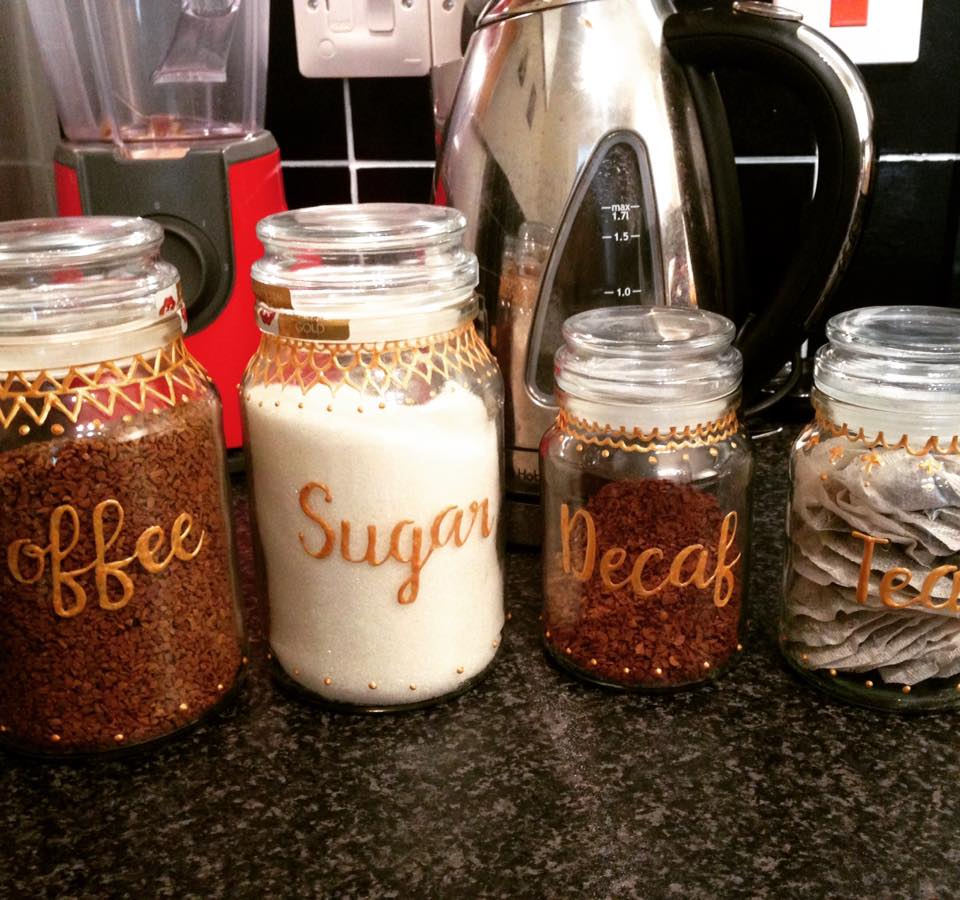 |
| Coffee jars |
 |
| Stag heart |
2017
So the big news of 2017 is that I have been diagnosed with coeliac disease...yay? Kind of yay, but kind of boo. Basically, this just means that my body hates itself and if I eat anything with gluten in it (i.e. anything tasty and awesome: bread, cakes, pastry, biscuits, cereal, and loads of other random foods that they sneak gluten into for no apparent reason) then my body goes mental and attacks my insides and I feel awful and sick and get horrible stomach pains etc. I had the endoscopy in early January, which was horrible. Awful. So so so so bad. I swear the sedation did nothing and the throat spray burned but didn't prevent the sore throat I had for a week afterwards. Really hope I don't ever need another! I got my results through just last week, which said that yes, I do have coeliac disease and my life will never be the same again. The good news is all I have to do is cut out gluten (easier said than done!) and then I'll be a-okay :) The bad news is, I want ALL the tasty gluteny cakes! But cutting out these foods will make me better, and is the only treatment for coeliac disease, so we'll see how it goes, I'll keep you posted.
 |
| I'll never be able to eat this sort-of delicious-looking, slightly OTT on the food colouring rainbow cake :( |
In other news, I for some reason am taking part in a bird race with some other folks in the office. Which is cool and all, I don't really do much birding and I don't ususally keep lists so it will be nice to keep track. However, this is mostly because I'm a rubbish birder! I'm doing ok so far (I think) but we'll see how it goes. I've been posting updates on Twitter, so follow me on there (@SarahBirding) if you want to keep track of how i'm doing! Highlights so far: hawfinch (a lifer for me!), American wigeon, and of course capercaillie! It just wouldn't be the same without those big black turkeys :)
I think that's all so far, check back soon for (hopefully regular) updates of my weird life!


